Why Your MMR Sucks in Valorant
Frustrated by tiny RR gains after wins and massive drops after losses? You’re not alone—most Valorant players feel the grind. In this post you’ll learn why the hidden MMR system is the real culprit, how it breaks the ranking ladder, and three concrete moves you can apply tonight to stop the swing.
What You’ll Gain By Understanding the Hidden MMR
Understanding the hidden rating gives you control over RR swings, not the other way around. By decoding Encounter MMR and Win‑Versus‑Loss MMR, you’ll see exactly which stats push your hidden score up. This knowledge lets you climb faster without endless grinding.
Here’s the thing: your visible visual rank is just a façade, while a secret number pulls the strings behind every win and loss. It can sit a full division above or below what the ladder shows, and it updates far quicker than you think. Ignoring it means you’re constantly fighting an invisible opponent.
Play solo or duo queue to maximize hidden MMR gain
Focus on individual performance (KDA, round wins) rather than just winning
Avoid surrendering; each extra round saves hidden MMR
Play consistently 4‑6 games daily instead of marathon sessions
Use an alt account to limit losses after two defeats in a day
The hidden MMR is the true engine of your rank; if you don’t understand it, you’ll never master the ladder.
Why does hidden MMR cause erratic RR gains?
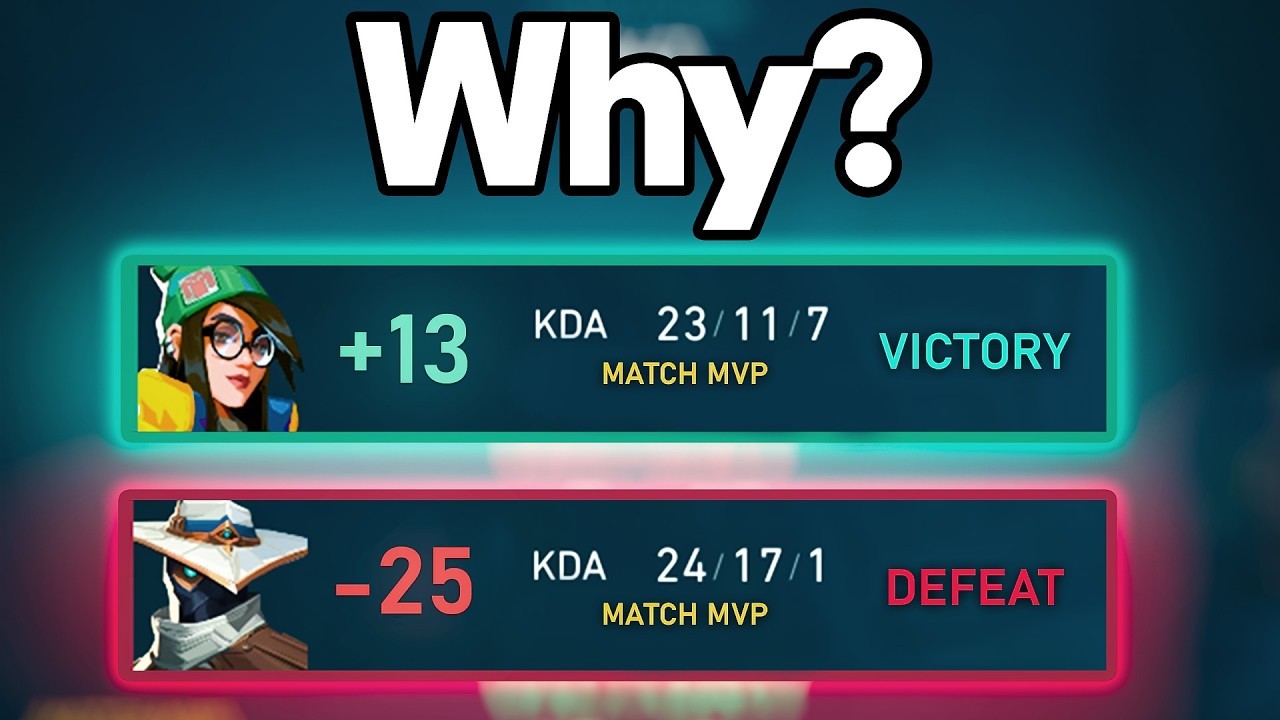
Hidden MMR determines the amount of RR you earn or lose on each match, so when the hidden value lags behind your visual rank, wins reward you with as little as 13 RR while losses can strip 25 RR, creating wildly inconsistent progress.
The system treats hidden MMR as the true skill metric. If you’re placed in Gold 3 but your hidden rating is still at Silver 3, the algorithm assumes you’re over‑ranked and penalizes you heavily, which explains why you can lose rank despite winning several games in a row.
But wait: there’s more than just a simple mismatch. The hidden rating updates after every round, not just after the final result, so even a single lost round can tip the balance.
How does Encounter MMR affect low‑rank players?
Encounter MMR measures how well you perform against opponents of similar or higher rank, using KDA, kills, assists, and trades. At lower tiers, each kill or trade can shift this hidden score by several points, meaning a single strong performance can boost your RR gains dramatically, while a poor game drags you down.
Riot’s dev Evermore confirmed that Encounter MMR has a heavier weight early in the ladder. A player in Iron 2 who improves their KDA from 0.8 to 1.2 can see hidden MMR jump a full division, translating to faster RR climbs.
Want to know the best part? The same mechanic that hurts you can be weaponized.
What is Win‑Versus‑Loss MMR and why does it matter for high‑elo?
Win‑Versus‑Loss MMR tracks your overall win‑loss ratio, round differentials, and total games played, acting as a long‑term stability gauge. At high elo, where Encounter MMR barely moves, this hidden component becomes the primary driver of rank changes, meaning insufficient game volume can stall your ascent even with a solid win rate.
If you reach Immortal but only play ten games per act, your win‑versus‑loss MMR lags behind your visible rank, causing frequent RR drops despite a high win percentage. Pros counter this by playing consistently and using alt accounts to keep the main hidden score stable.
How do pros exploit the hidden MMR system?
Professional players leverage the hidden MMR by chaining long win streaks, minimizing game volume after hitting a peak, and using alternate accounts for practice, all of which inflate their hidden score while preserving main‑account RR. This lets them maintain Immortal or Radiant status with far fewer matches than the average player.
Kane Zera, for instance, boasts a 70 % win rate and over 1200 RR while playing far fewer games per act than his peers, proving that a high hidden MMR can compensate for low playtime. He ends each act above his starting point, granting a carry‑over boost to the next act.
Maintain long win streaks to surge hidden MMR quickly
Reduce main‑account games after reaching a new rank peak
Use an alt account of similar elo for loss‑limiting practice
Finish each act with a higher hidden MMR than you started
Prioritize solo/duo queue to maximize individual impact
What practical steps can you take to mitigate the hidden MMR flaw?
You can tame the hidden MMR by playing consistently, focusing on individual performance, and strategically managing losses. Aim for 4‑6 games daily, prioritize solo or duo queue, avoid surrendering, and cap losses at two per day before switching to an alt account for low‑risk practice.
Start by tracking your KDA and aim to improve by 0.2 each week; a +1 KDA improvement often translates to a hidden MMR bump of several points. Then, set a daily loss limit and switch to an alt after reaching it, preserving your main’s hidden score while still sharpening mechanics.
Record your KDA and aim for a 0.2 weekly increase
Play 4‑6 ranked games each day, spaced out
Choose solo or duo queue whenever possible
Never surrender; win at least one extra round on a losing map
After two losses, log into an alt account for practice
A Fresh Takeaway
The hidden MMR isn’t a glitch; it’s a deliberate design that rewards consistency and individual skill over sheer volume. The fastest way to outsmart it is to treat each round as a hidden‑score opportunity and protect your main account with disciplined loss‑limiting. Right now, open your match history, note your KDA, and set a two‑loss daily cap—your RR will thank you.